PyJSON5
A JSON5 serializer and parser library for Python 3 written in Cython.
The serializer returns ASCII data that can safely be used in an HTML template. Apostrophes, ampersands, greater-than, and less-then signs are encoded as unicode escaped sequences. E.g. this snippet is safe for any and all input:
"<a onclick='alert(" + encode(data) + ")'>show message</a>"
Unless the input contains infinite or NaN values, the result will be valid JSON data.
All valid JSON5 1.0.0 and JSON data can be read, unless the nesting level is absurdly high.
Function summary
decode(data[, maxdepth, some]) |
Decodes JSON5 serialized data from an str object. |
decode_buffer(obj[, maxdepth, some, wordlength]) |
Decodes JSON5 serialized data from an object that supports the buffer protocol, e.g. |
decode_callback(cb[, maxdepth, some, args]) |
Decodes JSON5 serialized data by invoking a callback. |
decode_io(fp[, maxdepth, some]) |
Decodes JSON5 serialized data from a file-like object. |
decode_latin1(data[, maxdepth, some]) |
Decodes JSON5 serialized data from a bytes object. |
dump(obj, fp, **kw) |
Serializes a Python object to a JSON5 compatible unicode string. |
dumps(obj, **kw) |
Serializes a Python object to a JSON5 compatible unicode string. |
encode(data, *[, options]) |
Serializes a Python object to a JSON5 compatible unicode string. |
encode_bytes(data, *[, options]) |
Serializes a Python object to a JSON5 compatible bytes string. |
encode_callback(data, cb[, supply_bytes, …]) |
Serializes a Python object into a callback function. |
encode_io(data, fp[, supply_bytes, options]) |
Serializes a Python object into a file-object. |
encode_noop(data, *[, options]) |
Test if the input is serializable. |
load(fp, **kw) |
Decodes JSON5 serialized data from a file-like object. |
loads(s, *[, encoding]) |
Decodes JSON5 serialized data from a string. |
Class / exception summary
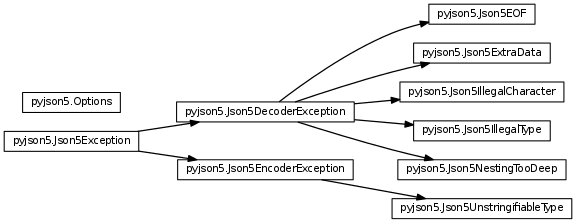
Full description
-
pyjson5.decode(data, maxdepth=None, some=False)¶ Decodes JSON5 serialized data from an
strobject.decode('["Hello", "world!"]') == ['Hello', 'world!']
Parameters: - data (unicode) – JSON5 serialized data
- maxdepth (Optional[int]) –
Maximum nesting level before are the parsing is aborted.
- If
Noneis supplied, then the value of the global variableDEFAULT_MAX_NESTING_LEVELis used instead. - If the value is
0, then only literals are accepted, e.g.false,47.11, or"string". - If the value is negative, then the any nesting level is allowed until Python’s recursion limit is hit.
- If
- some (bool) – Allow trailing junk.
Raises: Json5DecoderException– An exception occured while decoding.TypeError– An argument had a wrong type.
Returns: Deserialized data.
Return type:
-
pyjson5.decode_latin1(data, maxdepth=None, some=False)¶ Decodes JSON5 serialized data from a
bytesobject.decode_buffer(b'["Hello", "world!"]') == ['Hello', 'world!']
Parameters: Raises: Json5DecoderException– An exception occured while decoding.TypeError– An argument had a wrong type.
Returns: see decode(…)
Return type:
-
pyjson5.decode_buffer(obj, maxdepth=None, some=False, wordlength=None)¶ Decodes JSON5 serialized data from an object that supports the buffer protocol, e.g. bytearray.
obj = memoryview(b'["Hello", "world!"]')

decode_buffer(obj) == ['Hello', 'world!']
Parameters: - data (object) – JSON5 serialized data.
The argument must support Python’s buffer protocol, i.e.
memoryview(...)must work. The buffer must be contigious. - maxdepth (Optional[int]) – see decode(…)
- some (bool) – see decode(…)
- wordlength (Optional[int]) – Must be 1, 2, 4 to denote UCS1, USC2 or USC4 data.
Surrogates are not supported. Decode the data to an
strif need be. IfNoneis supplied, then the buffer’sitemsizeis used.
Raises: Json5DecoderException– An exception occured while decoding.TypeError– An argument had a wrong type.ValueError– The value ofwordlengthwas invalid.
Returns: see decode(…)
Return type: - data (object) – JSON5 serialized data.
The argument must support Python’s buffer protocol, i.e.
-
pyjson5.decode_callback(cb, maxdepth=None, some=False, args=None)¶ Decodes JSON5 serialized data by invoking a callback.
cb = iter('["Hello","world!"]').__next__

decode_callback(cb) == ['Hello', 'world!']
Parameters: - cb (Callable[Any, Union[str|bytes|bytearray|int|None]]) –
A function to get values from. The functions is called like
cb(*args), and it returns:- str, bytes, bytearray:
len(...) == 0denotes exhausted input.len(...) == 1is the next character. - int:
< 0denotes exhausted input.>= 0is the ordinal value of the next character. - None: input exhausted
- str, bytes, bytearray:
- maxdepth (Optional[int]) – see decode(…)
- some (bool) – see decode(…)
- args (Optional[Iterable[Any]]) – Arguments to call
cbwith.
Raises: Json5DecoderException– An exception occured while decoding.TypeError– An argument had a wrong type.
Returns: see
decode(...)Return type: - cb (Callable[Any, Union[str|bytes|bytearray|int|None]]) –
-
pyjson5.decode_io(fp, maxdepth=None, some=True)¶ Decodes JSON5 serialized data from a file-like object.
fp = io.StringIO("""
    ['Hello', /* TODO look into specs whom to greet */]
    'Wolrd' // FIXME: look for typos
""")

decode_io(fp) == ['Hello']
decode_io(fp) == 'Wolrd'

fp.seek(0)

decode_io(fp, some=False)
# raises Json5ExtraData('Extra data U+0027 near 56', ['Hello'], "'")
Parameters: Raises: Json5DecoderException– An exception occured while decoding.TypeError– An argument had a wrong type.
Returns: see
decode(...)Return type:
-
pyjson5.encode(data, *, options=None, **options_kw)¶ Serializes a Python object to a JSON5 compatible unicode string.
encode(['Hello', 'world!']) == '["Hello","world!"]'
Parameters: Raises: Json5EncoderException– An exception occured while encoding.TypeError– An argument had a wrong type.
Returns: Unless
float('inf')orfloat('nan')is encountered, the result will be valid JSON data (as of RFC8259).The result is always ASCII. All characters outside of the ASCII range are encoded.
The result safe to use in an HTML template, e.g.
<a onclick='alert({{ encode(url) }})'>show message</a>. Apostrophes"'"are encoded as"\u0027", less-than, greater-than, and ampersand likewise.Return type:
-
pyjson5.encode_bytes(data, *, options=None, **options_kw)¶ Serializes a Python object to a JSON5 compatible bytes string.
encode_bytes(['Hello', 'world!']) == b'["Hello","world!"]'
Parameters: Raises: Json5EncoderException– An exception occured while encoding.TypeError– An argument had a wrong type.
Returns: see encode(…)
Return type:
-
pyjson5.encode_callback(data, cb, supply_bytes=False, *, options=None, **options_kw)¶ Serializes a Python object into a callback function.
The callback function
cbgets called with single characters and strings until the inputdatais fully serialized.encode_callback(['Hello', 'world!'], print) #prints: # [ # " # Hello # " # , # " # world! # " " ]
Parameters: - data (object) – see encode(…)
- cb (Callable[[Union[bytes|str]], None]) – A callback function.
Depending on the truthyness of
supply_byteseitherbytesorstris supplied. - supply_bytes (bool) – Call
cb(...)with abytesargument if true, otherwisestr. - options (Optional[Options]) – see encode(…)
- options_kw – see encode(…)
Raises: Json5EncoderException– An exception occured while encoding.TypeError– An argument had a wrong type.
Returns: The supplied argument
cb.Return type: Callable[[Union[bytes|str]], None]
-
pyjson5.encode_io(data, fp, supply_bytes=True, *, options=None, **options_kw)¶ Serializes a Python object into a file-object.
The return value of
fp.write(...)is not checked. Iffpis unbuffered, then the result will be garbage!Parameters: Raises: Json5EncoderException– An exception occured while encoding.TypeError– An argument had a wrong type.
Returns: The supplied argument
fp.Return type: IOBase
-
pyjson5.encode_noop(data, *, options=None, **options_kw)¶ Test if the input is serializable.
Most likely you want to serialize
datadirectly, and catch exceptions instead of using this function!encode_noop({47: 11}) == True encode_noop({47: object()}) == False
Parameters: Returns: Trueiffdatais serializable.Return type:
-
class
pyjson5.Options¶ Customizations for the
encoder_*(...)function family.Immutable. Use
Options.update(**kw)to create a new Options instance.Parameters: - tojson (str|False|None) –
- str: A special method to call on objects to return a custom JSON encoded string. Must return ASCII data!
- False: No such member exists. (Default.)
- None: Use default.
- posinfinity (str|False|None) –
- str: String to represent positive infinity. Must be ASCII.
- False: Throw an exception if
float('+inf')is encountered. - None: Use default:
"Infinity".
- neginfinity (str|False|None) –
- str: String to represent negative infinity. Must be ASCII.
- False: Throw an exception if
float('-inf')is encountered. - None: Use default:
"-Infinity".
- nan (str|False|None) –
- str: String to represent not-a-number. Must be ASCII.
- False: Throw an exception if
float('NaN')is encountered. - None: Use default:
"NaN".
- intformat (str|False|None) –
- str: Format string to use with
int. - False: Throw an exception if an
intis encountered. - None: Use default:
"%d".
- str: Format string to use with
- floatformat (str|False|None) –
- str: Format string to use with
float. - False: Throw an exception if a
floatis encountered. - None: Use default:
"%.6e".
- str: Format string to use with
- decimalformat (str|False|None) –
- str: Format string to use with
Decimal. - False: Throw an exception if a
Decimalis encountered. - None: Use default:
"%s".
- str: Format string to use with
- mappingtypes (Iterable[type]|False|None) –
- Iterable[type]: Classes the should be encoded to objects. Must be iterable over their keys, and implement
__getitem__. - False: There are no objects. Any object will be encoded as list of key-value tuples.
- None: Use default:
[collections.abc.Mapping].
- Iterable[type]: Classes the should be encoded to objects. Must be iterable over their keys, and implement
-
decimalformat¶ The creation argument
decimalformat.NoneifFalsewas specified.
-
floatformat¶ The creation argument
floatformat.NoneifFalsewas specified.
-
intformat¶ The creation argument
intformat.NoneifFalsewas specified.
-
mappingtypes¶ The creation argument
mappingtypes.()ifFalsewas specified.
-
nan¶ The creation argument
nan.NoneifFalsewas specified.
-
neginfinity¶ The creation argument
neginfinity.NoneifFalsewas specified.
-
posinfinity¶ The creation argument
posinfinity.NoneifFalsewas specified.
-
tojson¶ The creation argument
tojson.NoneifFalsewas specified.
-
update(self, **kw)¶ Creates a new Options instance by modifying some members.
- tojson (str|False|None) –
-
pyjson5.loads(s, *, encoding='UTF-8', **kw)¶ Decodes JSON5 serialized data from a string.
Use decode(…) instead!
loads(s) == decode(s)
Parameters: Returns: see
decode(...)Return type:
-
pyjson5.load(fp, **kw)¶ Decodes JSON5 serialized data from a file-like object.
Use decode_io(…) instead!
load(fp) == decode_io(fp, None, False)
Parameters: - fp (IOBase) – A file-like object to parse from.
- kw – Silently ignored.
Returns: see
decode(...)Return type:
-
pyjson5.dumps(obj, **kw)¶ Serializes a Python object to a JSON5 compatible unicode string.
Use encode(…) instead!
dumps(obj) == encode(obj)
Parameters: - obj (object) – Python object to serialize.
- kw – Silently ignored.
Returns: see
encode(data)Return type: unicode
-
pyjson5.dump(obj, fp, **kw)¶ Serializes a Python object to a JSON5 compatible unicode string.
Use encode_io(…) instead!
dump(obj, fp) == encode_io(obj, fp)
Parameters: - obj (object) – Python object to serialize.
- fp (IOBase) – A file-like object to serialize into.
- kw – Silently ignored.
-
exception
pyjson5.Json5Exception(message=None, *args)¶ Base class of any exception thrown by PyJSON5.
-
message¶ Human readable error description
-
with_traceback()¶ Exception.with_traceback(tb) – set self.__traceback__ to tb and return self.
-
-
exception
pyjson5.Json5EncoderException¶ Base class of any exception thrown by the serializer.
-
message¶ Human readable error description
-
with_traceback()¶ Exception.with_traceback(tb) – set self.__traceback__ to tb and return self.
-
-
exception
pyjson5.Json5UnstringifiableType(message=None, unstringifiable=None)¶ The encoder was not able to stringify the input, or it was told not to by the supplied
Options.-
message¶ Human readable error description
-
unstringifiable¶ The value that caused the problem.
-
with_traceback()¶ Exception.with_traceback(tb) – set self.__traceback__ to tb and return self.
-
-
exception
pyjson5.Json5DecoderException(message=None, result=None, *args)¶ Base class of any exception thrown by the parser.
-
message¶ Human readable error description
-
result¶ Deserialized data up until now.
-
with_traceback()¶ Exception.with_traceback(tb) – set self.__traceback__ to tb and return self.
-
-
exception
pyjson5.Json5NestingTooDeep¶ The maximum nesting level on the input data was exceeded.
-
message¶ Human readable error description
-
result¶ Deserialized data up until now.
-
with_traceback()¶ Exception.with_traceback(tb) – set self.__traceback__ to tb and return self.
-
-
exception
pyjson5.Json5EOF¶ The input ended prematurely.
-
message¶ Human readable error description
-
result¶ Deserialized data up until now.
-
with_traceback()¶ Exception.with_traceback(tb) – set self.__traceback__ to tb and return self.
-
-
exception
pyjson5.Json5IllegalCharacter(message=None, result=None, character=None, *args)¶ An unexpected character was encountered.
-
character¶ Extranous character.
-
message¶ Human readable error description
-
result¶ Deserialized data up until now.
-
with_traceback()¶ Exception.with_traceback(tb) – set self.__traceback__ to tb and return self.
-
-
exception
pyjson5.Json5ExtraData(message=None, result=None, character=None, *args)¶ The input contained extranous data.
-
character¶ Extranous character.
-
message¶ Human readable error description
-
result¶ Deserialized data up until now.
-
with_traceback()¶ Exception.with_traceback(tb) – set self.__traceback__ to tb and return self.
-
-
exception
pyjson5.Json5IllegalType(message=None, result=None, value=None, *args)¶ The user supplied callback function returned illegal data.
-
message¶ Human readable error description
-
result¶ Deserialized data up until now.
-
value¶ Value that caused the problem.
-
with_traceback()¶ Exception.with_traceback(tb) – set self.__traceback__ to tb and return self.
-